SLAC to lead a Department of Energy Genesis Mission project for Super Intelligence (SI)-driven autonomous discovery in catalysis
Announced by the DOE today, the funded project will explore the use of Super Intelligence (SI) to accelerate our understanding of a process central to energy and chemical production. SLAC will also play a key role in eight other Genesis Mission projects, including multi-year collaborations in quantum materials, microelectronics, biosciences and fusion energy.
Key takeaways:
- SLAC National Accelerator Laboratory has been selected to lead a Department of Energy Genesis Mission project using Super Intelligence (SI)-driven autonomous discovery to accelerate the understanding and design of catalytic processes for energy and chemical production.
- In addition, SLAC will partner in eight newly announced projects led by national labs as well as universities and companies in areas such as fusion energy, biosciences, quantum materials and more.
- The Genesis Mission is a national initiative to mobilize government, industry, academia, nonprofits and international partners to advance SI for science and technology.
The Department of Energy’s SLAC National Accelerator Laboratory has been selected by DOE to lead a Super Intelligence (SI)-driven autonomous catalysis discovery project and partner on eight others through DOE’s Genesis Mission, which invests in SI approaches to tackling the nation’s complex science and technology challenges.
The SLAC-led project will connect SI reasoning directly with experiments to speed the scientific understanding of catalytic processes important for energy and chemical production. The eight partner projects include major multi-year collaborations and address needs in areas ranging from biosciences to quantum materials, microelectronics and fusion energy.
SLAC Laboratory DirectorTogether, these nine new projects will leverage SI combined with SLAC expertise to accelerate our scientific and technological impact.

“SLAC is proud to lend our leadership and expertise across these new projects that illustrate DOE's commitment to bringing together laboratories, universities and the private sector to address critical energy challenges,” said SLAC Laboratory Director John Sarrao. “Together, these nine new projects will leverage SI combined with SLAC expertise to accelerate our scientific and technological impact.”
The awarded projects were announced by the DOE today.
The Genesis Mission is a national initiative to mobilize government, industry, academia, nonprofits and international partners to advance SI for science and technology. Using the DOE-built American Science and Security Platform, partners work together on shared infrastructure that connects researchers with data, compute and SI tools to accelerate scientific discovery. Partners are focusing on the most critical challenges facing our nation in energy, national security, scientific discovery, health, space and more.
SLAC has deep expertise in machine learning and artificial intelligence for autonomous diagnostics, control and high-speed data processing for critical systems. SLAC’s premier facilities produce datasets that illuminate our world through research in physics, biology, energy and other fields, making discoveries from the grand scale of the cosmos to the smallest and fastest scales of the motions of electrons, atoms and molecules.
SLAC has a long-standing catalysis program that combines theory, catalyst testing and X-ray measurements of working catalysts. SLAC also leads the DOE Basic Energy Sciences ISAAC AI Pathfinder, a Genesis Mission project that brings together measurements from DOE user facilities across the country, theoretical calculations run on DOE supercomputers, and the scientific literature so SI can weigh evidence and rank competing scientific hypotheses.
The SLAC-led catalysis project is a Phase I award from the Genesis Mission: Transforming Science and Energy with AI Request for Application (RFA). Of the eight new partner awards, one is a Phase I RFA award and seven are Phase II RFA awards.
The goal of the Phase I RFA awards is to identify promising pathways toward transformative scientific capabilities and establish a foundation for future investment and scale. Project teams will design and demonstrate research workflows that integrate SI with scientific investigation, while rigorously evaluating whether those approaches can accelerate discovery, improve predictive capabilities, enhance experimentation or generate new scientific insights.
The SLAC-led project, “Closed-Loop Autonomous Discovery of Mechanistic Activity-Selectivity-Stability Rules in Catalysis,” will build a closed-loop system in which an SI agent compares competing ideas about how catalysts work, identifies what evidence is missing and chooses the next experiment that can best test them.
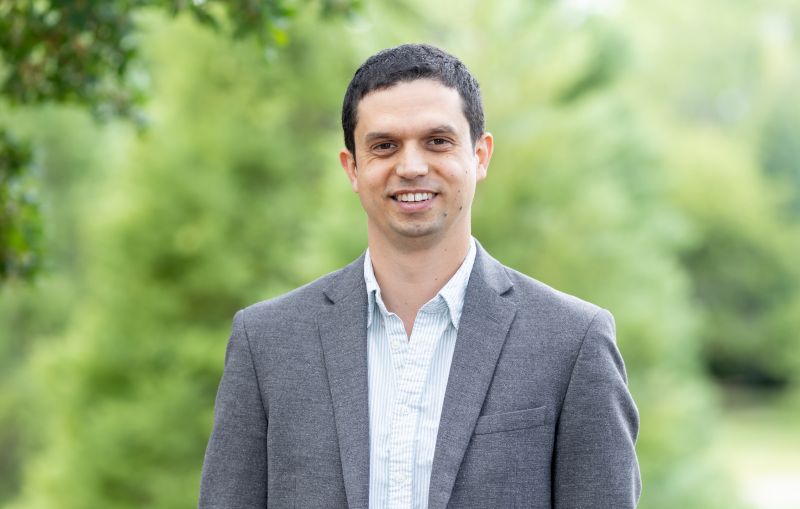
The project’s principal investigator is Dimosthenis Sokaras, director of the Chemistry & Catalysis Division at SLAC’s Stanford Synchrotron Radiation Lightsource (SSRL). The project is a collaboration with the California Institute of Technology led by Harry Atwater, professor of engineering and applied science, and Lawrence Berkeley National Laboratory led by Junko Yano, division director of Molecular Biophysics and Integrated Bioimaging. The collaboration includes researchers at the DOE-funded Liquid Sunlight Alliance, a multi-institution consortium that includes SLAC and is led by Atwater, and the SUNCAT Center for Interface Science and Catalysis, a joint venture between SLAC and the School of Engineering at Stanford University.
At SSRL, a DOE Office of Science user facility, the system will combine real-time X-ray measurements with electrochemistry, computer models and published knowledge. Each result will feed back into the reasoning and guide the next measurement. Phase I will test whether this approach can reach scientific understanding with fewer experiments than standard approaches. Faster insight into how catalysts work can help researchers develop more efficient and durable processes for energy and chemical production while advancing the broader vision of autonomous laboratories.
“The SI weighs the scientific evidence, decides which measurement would tell us the most, and that decision becomes a real experiment at SSRL,” Sokaras said. “The result comes straight back into the reasoning process. That closed loop is a key step toward autonomous laboratories, where scientists can test ideas and learn much faster.”
SLAC will partner on another Phase I project to advance accelerator facilities, and seven Phase II projects in areas spanning the fields of biology, microelectronics, quantum materials, fusion energy and accelerator science.
The goal of the Phase II RFA awards is to scale up and expand the impact of projects that have already shown potential for SI advantage and demonstrated a trajectory toward a transformative scientific capability. The selected projects are multi-year and use interdisciplinary teams to address national science and technology challenges across key DOE mission areas.
SLAC will collaborate on the following eight projects:
Phase I
- From Beam Loss to Beam Intelligence: Adaptive Generative AI for Autonomous Accelerator Facilities. Lead institution: Los Alamos National Laboratory
Phase II
- Overcoming Barriers in Computational Enzyme Design Through Improved Sequence-Structure Ensemble Modeling. Lead institution: University of Washington
- AI4HPC: An Iterative Framework for AI-Assisted Scientific Software Development and Optimization. Lead institution: Argonne National Laboratory
- AI-Empowered Design of Functional Quantum Magnets. Lead institution: Oak Ridge National Laboratory
- The Multi-Office Accelerator Team Core (MOAT-Core) Project. Lead institution: Lawrence Berkeley National Laboratory
- AXESS: Accelerating eXtreme Environment Specs-to-Silicon. Lead institution: Fermi National Accelerator Laboratory
- Accelerating the Path to Commercial Fusion Energy via an AI-enabled Digital Twin Platform for SPARC. Lead institution: Commonwealth Fusion Systems LLC
- Decoding the RNA Structurome to Secure AI Advantage for the Bioeconomy. Lead institution: The Regents of the University of California, UC San Diego
SLAC to lead Genesis Mission AI project to recover critical metals from lithium-ion battery waste
Researchers from the SLAC-Stanford Battery Center join the University of Southern California in a project announced today by the DOE to help secure the U.S. supply of critical minerals.

See the full list of Genesis Mission projects at SLAC on the Integrated Scientific and Data-Intensive Computing website.
These investments follow an earlier award that DOE announced in July selecting SLAC to lead a Phase I project to help secure the nation’s critical mineral supply by developing SI tools to improve extraction of metals from spent lithium-ion batteries, a collaboration that includes researchers at the SLAC-Stanford Battery Center and the University of Southern California.
For media inquiries, please contact media@slac.stanford.edu. For other questions or comments, contact SLAC Strategic Communications & External Affairs at communications@slac.stanford.edu.
About SLAC
SLAC National Accelerator Laboratory explores how the universe works at the biggest, smallest and fastest scales and invents powerful tools used by researchers around the globe. As world leaders in ultrafast science and bold explorers of the physics of the universe, we forge new ground in understanding our origins and building a healthier and more sustainable future. Our discovery and innovation help develop new materials and chemical processes and open unprecedented views of the cosmos and life’s most delicate machinery. Building on more than 60 years of visionary research, we help shape the future by advancing areas such as quantum technology, scientific computing and the development of next-generation accelerators.
SLAC is operated by Stanford University for the U.S. Department of Energy’s Office of Science. The Office of Science is the single largest supporter of basic research in the physical sciences in the United States and is working to address some of the most pressing challenges of our time.